
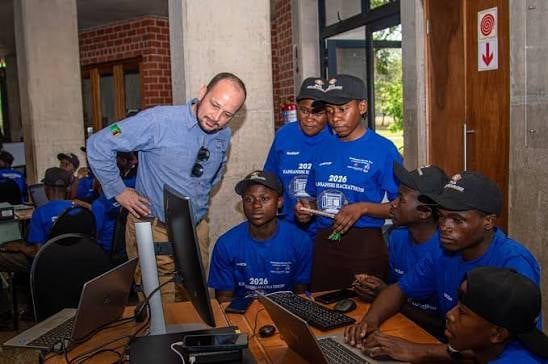
For four days in September, the conversation in Solwezi was not about copper — it was about code. From 21 to 24 September 2026, Kansanshi Mining PLC handed over 105 computers to five schools in its catchment area, donated another 60 computers to Copperbelt University, and hosted the second edition of the Kansanshi Education AI Hackathon.
Together, those two moves put 165 devices into the hands of learners and students, and turned a working mining town into one of the most active AI classrooms in the country.
165 Computers, Two Recipients
The handover was the centrepiece of the week. 105 computers went to five schools within Kansanshi's catchment area — closing a long-standing equipment gap in schools that many of the pupils themselves, their parents, or their older siblings have walked past on the way to work at the mine.
A further 60 computers went to Copperbelt University, strengthening the higher-education pipeline that mining-linked industries depend on. For CBU, the timing matters: computer science, data, and engineering students now have current-generation hardware to test and build on, not just to read about in textbooks.
The Second Kansanshi Education AI Hackathon
The handover coincided with the second Kansanshi Education AI Hackathon — a deliberately practical event, not a showcase. 105 pupils from 21 schools, working alongside CBU students, were asked one question: can you build an AI solution for a problem mining and mining communities actually face?
The teams' projects clustered around four areas:
Safety reporting. Tools that make it easier for workers and supervisors to log near-misses, hazards, and incidents in real time — turning paper-based reporting into structured data that a mine's safety team can actually act on.
Equipment monitoring. Lightweight models that watch sensor streams for early warning signs of failure on pumps, conveyors, and other critical kit — the kind of work that usually requires a much more specialised team.
Smart checklists. Mobile-friendly, role-specific checklists that adapt based on what a worker enters — replacing static forms with a tool that prompts the next question and flags anomalies as they appear.
Ore classification. Computer-vision models trained to recognise and classify ore samples from images — a task typically handled by experienced geologists with the naked eye.
Why This Model Matters for Zambia
What makes Kansanshi's approach interesting is not the volume of equipment alone — it is the pairing of equipment with a real problem. The donations land in the same week as the hackathon, so the devices arrive in a context where they are immediately put to work on problems the surrounding industry cares about.
That changes the way learners experience AI. Instead of "write a chatbot for an imaginary customer," they are working on safety reporting, ore classification, and equipment monitoring — the same problems facing one of the largest employers in their district.
It also creates a cleaner pipeline. A pupil who builds an ore-classification model at age 16 is not starting from zero at university — they already know what labelled data looks like, what a model's failure modes feel like, and what a geologist actually needs from a tool.
What the Numbers Add Up To
Across four days: 165 computers handed over, 105 pupils from 21 schools, 60 machines for Copperbelt University, and four working AI problem areas shaped by a single mine. It is a compact demonstration of what coordinated industry-education partnerships can produce when the equipment, the curriculum, and the problem set are pulled together in one week rather than scattered across different timelines.
The Bigger Picture
At Digital Literacy Consultants, we follow stories like this closely. The same model — devices donated into a learning context where they are immediately used on real industry problems — is what we work to build with schools, universities, and corporate partners across Zambia.
If your organisation is exploring a similar partnership — whether that's equipping a school, running an industry-linked hackathon, or building a digital lab alongside a training programme — let's talk.