
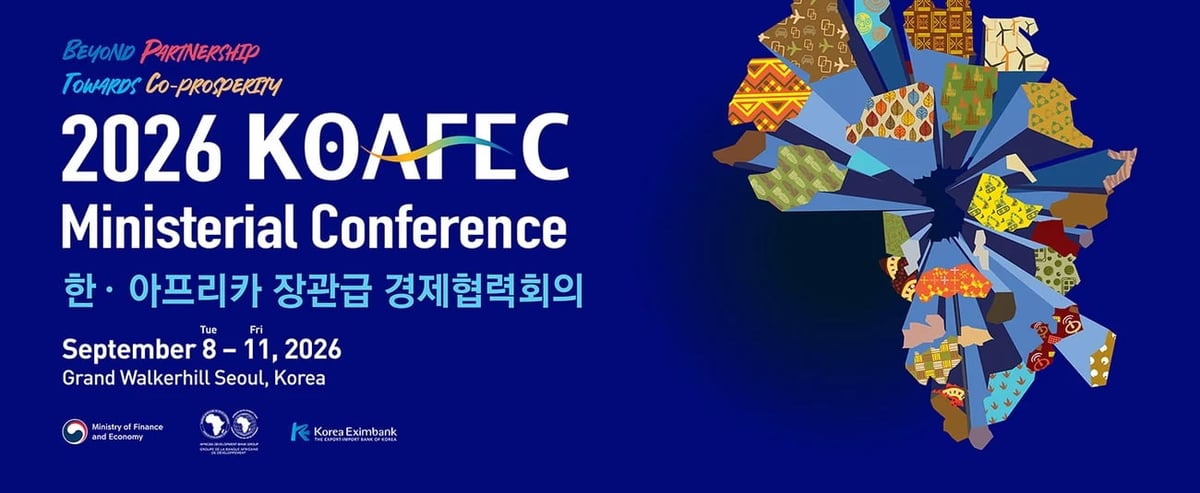
The Korea-Africa Economic Cooperation (KOAFEC) Ministerial Conference returns on 8 to 11 September 2026 at the Grand Walkerhill Seoul, Korea. Convened under the theme "Beyond Partnership, Towards Co-Prosperity," the conference is expected to produce a new action plan for Korea-Africa cooperation across five priority areas: artificial intelligence, digital transformation, infrastructure, energy, and human capital.
Why This Conference Matters
KOAFEC is the African Development Bank Group's flagship platform for Korea-Africa dialogue — bringing together African ministers, development finance leaders, and Korean public and private sector actors to align priorities and unlock concrete cooperation. The 2026 edition lands at a moment when both regions are recalibrating their digital and energy strategies in response to the rapid rise of AI, the transition to cleaner energy, and the urgent need to close infrastructure gaps.
What makes KOAFEC useful is its blend of high-level policy dialogue and practical engagement. The agenda is built around commitments, not just statements. The action plan expected from this year's meeting will set the tone for Korea-Africa cooperation through the next planning cycle — including the kinds of partnerships, financing arrangements, and capacity-building programmes that African countries, including Zambia, will engage with.
The Five Priority Areas
The expected action plan is structured around five themes that map directly onto the most pressing questions facing African economies:
1. Artificial Intelligence. Korea is a global leader in AI adoption and chip manufacturing. For African countries, the question is how to access that expertise while building AI systems that reflect African contexts and priorities. Expect cooperation to focus on shared research, infrastructure, and AI skills development.
2. Digital Transformation. Beyond AI, broader digital transformation — digital government, broadband infrastructure, fintech, e-commerce — remains the backbone of any modern economy. Korea's experience scaling these systems at speed is one of the most relevant in the world.
3. Infrastructure. Africa's infrastructure deficit — physical and digital — is one of the most-cited constraints on growth. Korea's infrastructure financing models, particularly through the Economic Development Cooperation Fund (EDCF) and the Korea Eximbank, are likely to feature prominently.
4. Energy. Africa's energy transition is one of the defining challenges of the next decade. Korea brings world-class capability in renewables, grid technology, and energy storage — exactly the areas where African demand is growing fastest.
5. Human Capital. None of the above matters without people. Skills, training, and education are the connective tissue of any successful cooperation programme. This is the area where Korea's experience is most directly transferable to African countries investing in their own talent pipelines.
What This Means for Zambia
Zambia is unlikely to leave KOAFEC with a single headline agreement — but the conversations and commitments made in Seoul shape the cooperation frameworks that flow downstream into ministries, agencies, and training institutions for years afterwards. That matters.
Three priorities stand out for Zambia:
AI capacity. Zambia's National AI Strategy is in its final stages. The partnerships and financing that emerge from KOAFEC can accelerate the rollout of training programmes, research collaboration, and infrastructure investment that the strategy depends on.
Digital government. Programmes like the Government Wide Area Network (GWAN), which is connecting Zambia's 116 councils, benefit from international financing and technology partnerships. KOAFEC is one of the venues where these deals take shape.
Skills at scale. No cooperation framework delivers without the people to absorb it. The work we do at Digital Literacy Consultants — building AI literacy, digital productivity, and cybersecurity skills across schools, public institutions, and businesses — is the on-the-ground capacity that makes international partnerships work.
Looking Ahead
The 2026 KOAFEC Ministerial Conference is more than a diplomatic gathering. It is a checkpoint for Korea-Africa cooperation at a moment of significant technological and economic change. The action plan that emerges will shape the next chapter of partnership between two regions whose futures are increasingly linked.
We will be watching closely, and we will report on the outcomes that matter most for Zambia's digital and AI future.